
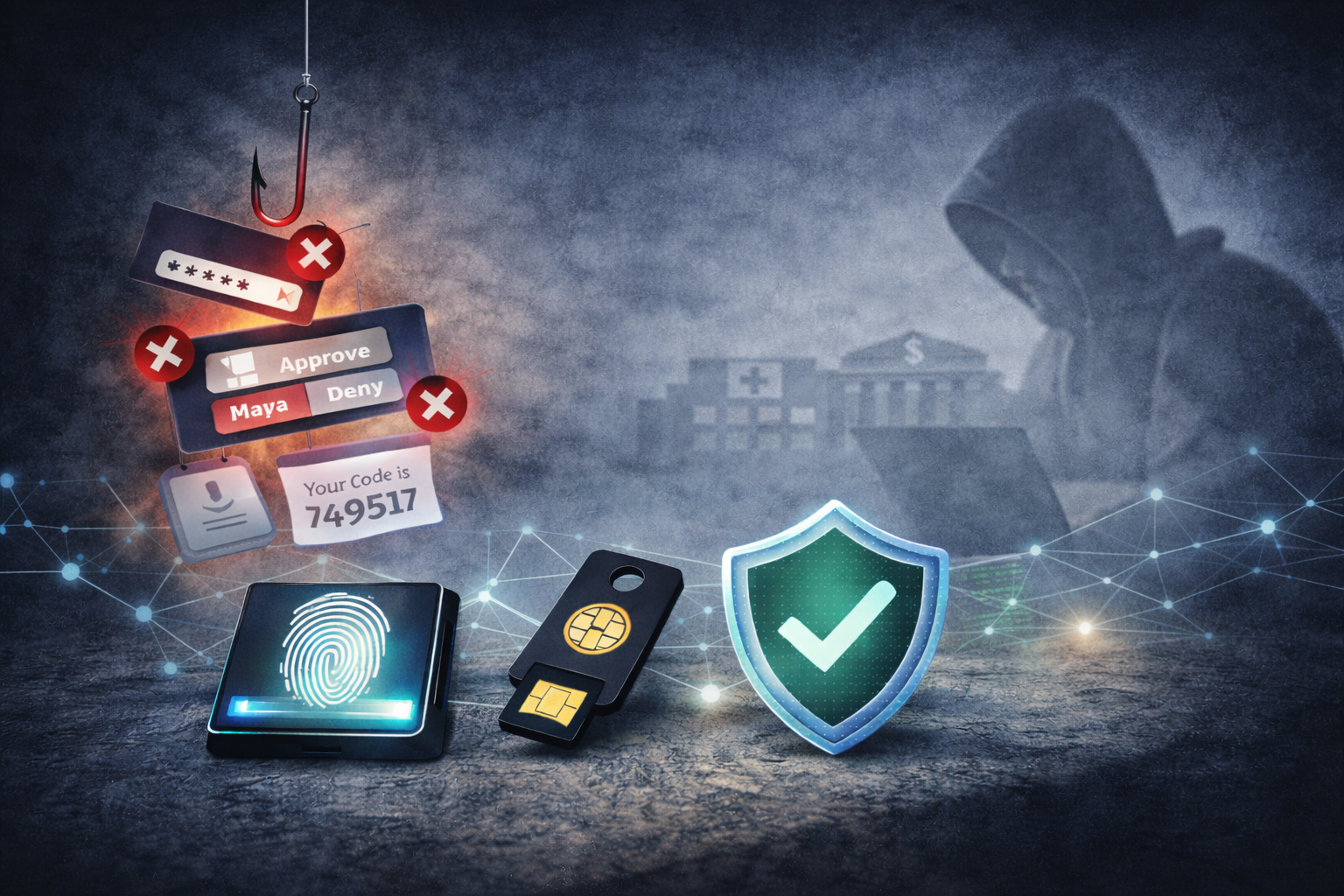
The FBI Just Said the Quiet Part Out Loud: Phishing-Resistant Authentication Is Job One
By Kevin Surace | 7 minute read
For years, security leaders have debated frameworks, tools, awareness programs, and incremental improvements to authentication workflows, while attackers continued to succeed through the same predictable path: logging in with stolen or relayed credentials rather than breaking through hardened infrastructure.
Now the FBI has made it explicit.
As part of Operation Winter Shield, the Federal Bureau of Investigation (FBI) has made clear that organizations must prioritize phishing-resistant authentication if they intend to stop modern attacks at their source.
Not stronger password policies.
Not additional MFA prompts layered onto compromised workflows.
Not expanded user training modules.
Phishing-resistant authentication.
You can read it directly in the FBI guidance summarized here.
The FBI just said the quiet part… This is not incremental change. It is a line in the sand.
Why the FBI Is Saying This Now
The FBI is not reacting to hypothetical scenarios or emerging academic theory. Their position reflects patterns observed repeatedly in active investigations across healthcare, financial services, insurance, aviation, and government contracting environments.
Attackers are no longer primarily exploiting software flaws. They are exploiting identity systems and human workflows.
Real-time phishing kits now proxy legitimate login sessions. MFA relay attacks intercept approval flows in seconds. Help desk impersonation bypasses recovery procedures. Contractors and third parties become indirect entry points into otherwise well-defended enterprises.
Legacy MFA does not stop this pattern.
Authenticator applications do not stop this pattern.
SMS codes do not stop this pattern.
The FBI knows it. Attackers know it. The breach reports prove it.
What “Phishing-Resistant Authentication Actually” Means
Many organizations misinterpret the term. Phishing-resistant does not mean “harder to phish” or“less likely to be compromised.” It means structurally immune to phishing because the attack surface has been eliminated at the protocol level.
True phishing resistance requires removing human judgment from the authentication decision and replacing it with cryptographic certainty. That requires three elements operating together as a unified control plane:
- Biometric proof of the user
- Physical presence of the user
- Cryptographic binding to the legitimate domain
If any of these elements is absent, authentication must fail automatically and without exception.
Any system that still relies on a code being read aloud, a push notification being approved, or a user deciding whether something “looks legitimate” remains vulnerable by design. That is not a policy issue. It is a structural limitation.
Why Biometric Assured Identity Aligns with FBI Guidance
This is why federal guidance from the FBI and CISA consistently references phishing-resistant MFA built on FIDO standards and hardware-backed credentials.
Biometric assured identity platforms such as Token implement this model as intended.
There is no password to steal. There is no one-time code to relay. There is no push prompt to manipulate through fatigue or urgency. Authentication succeeds only when:
- The correct biometric is presented
- The user is physically present
- The request is cryptographically bound to the legitimate domain
A phishing page cannot satisfy these conditions. A social engineer cannot override them through persuasion. An attacker cannot replay them in real time. The system does not negotiate. It simply refuses to authenticate.
Why This Collapses Entire Classes of Attacks
Take a closer read of recent breach reports and you will see the same pattern repeated:
- A user clicked a malicious link.
- A contractor was socially engineered.
- An MFA code was shared.
- An attacker logged in.
With phishing-resistant biometric authentication, that chain of events cannot complete. Even if a malicious link is clicked, authentication cannot be proxied. Even if credentials are harvested, they are cryptographically useless.Even if a call is placed to the help desk, there is no transferable secret to disclose.
This is exactly what the FBI is trying to achieve with Operation Winter Shield. Not improved remediation after compromise, but structural prevention before compromise occurs.
The Message Could Not Be Clearer
The FBI is not asking politely or suggesting incremental optimization anymore. They are telling organizations what actually works: Phishing-resistant authentication is no longer optional. It is no longer “next phase.” It is job one.
Any strategy that depends on users making correct decisions under time pressure is misaligned with the threat environment. Mathematics will always outperform psychology.Cryptographic binding will always outperform awareness training.
Biometric assured identity is not a nice upgrade. It is the baseline necessary to prevent identity-driven compromise in a world where attackers have already adapted.
The attackers have changed their methods. The FBI has now made clear that defenders must do the same.
Sign Up
Keep up to date with phishing and ransomware news.
Token will not sell, trade, lease, or rent your personal data to third parties.